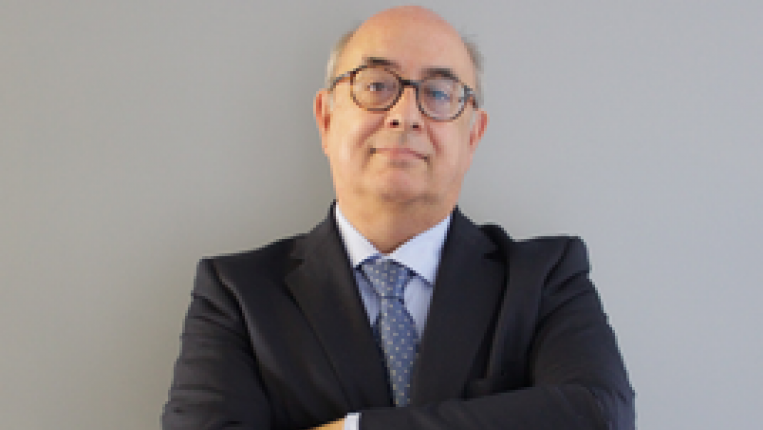
The first woman to preside over the Court of Auditors is the leading voice in the defense of public financial oversight, precisely at a time when the government intends to make prior approval an exception.
Filipa Urbano Calvão, the first woman to preside over the Court of Auditors (TdC), has never sought the spotlight. She grew up in a family where the law was practically her mother tongue, built an academic career, distinguished herself in the fields of regulation and data protection, and rose to the top of one of the state’s oldest institutions. Today, she is the leading voice in the defense of public financial oversight, precisely at a time when the government intends to make prior approval an exception in the amendments to the regulations governing the TdC.
She was born in Coimbra on December 31, 1970, but it was between Porto—where she grew up—and the family farm in Recardães, Águeda, that Filipa Urbano Calvão’s personality took shape. Her childhood was marked by family gatherings that brought together dozens of cousins, uncles, aunts, and grandparents during vacations and religious celebrations—a tradition that continues to this day.
The first woman to preside over the Court of Auditors is the leading voice in the defense of public financial oversight, precisely at a time when the government intends to make prior approval the exception.
In this family environment, there was one common thread: the law. Her choice of profession came almost naturally, influenced by her father, a well-known lawyer in Porto, and also by her cousin João Calvão da Silva, a professor at the University of Coimbra’s School of Law, a leading legal scholar, and a former Minister of Internal Administration. On her mother’s side, too, the law was part of the family’s history. Constança Urbano de Sousa, a former Minister of Internal Administration, and Benedita Urbano, a judge on the Constitutional Court, are just two examples of a family where public life and the law have always gone hand in hand.
Those who knew her from an early age speak of a determined personality. “She was a petite girl with a very lively personality—very cheerful and determined,” describes Constança Urbano de Sousa in an interview with DN. Today, she recognizes in the president of the Court of Auditors the same characteristics she observed in her childhood: “Technical competence, rigor, and excellence in the field of public law,” but also “the ability to manage people” and “a level-headed demeanor.” Not to mention a trait everyone recognizes in her: she is demanding.
She earned her law degree from the Portuguese Catholic University in Porto, as part of what many consider one of the institution’s most distinguished programs. She graduated second in her class, behind only António Frada, who is also a university professor.
Her academic record led the Portuguese Catholic University to invite her to teach immediately after she finished her degree. She made her teaching debut alongside Paulo Rangel, the current Minister of Foreign Affairs, co-teaching a fifth-year course. Among the students was a young man named Luís Montenegro.
Her academic career continued in Coimbra, where she completed her master’s degree in 1997 and her doctorate in 2009, both in Legal and Political Sciences. His leap to the forefront of public administration came in 2012, when he accepted the position of chair of the National Data Protection Commission. He put his law practice on hold and permanently shifted the focus of his work to Lisbon.
Read the full column in portuguese here.